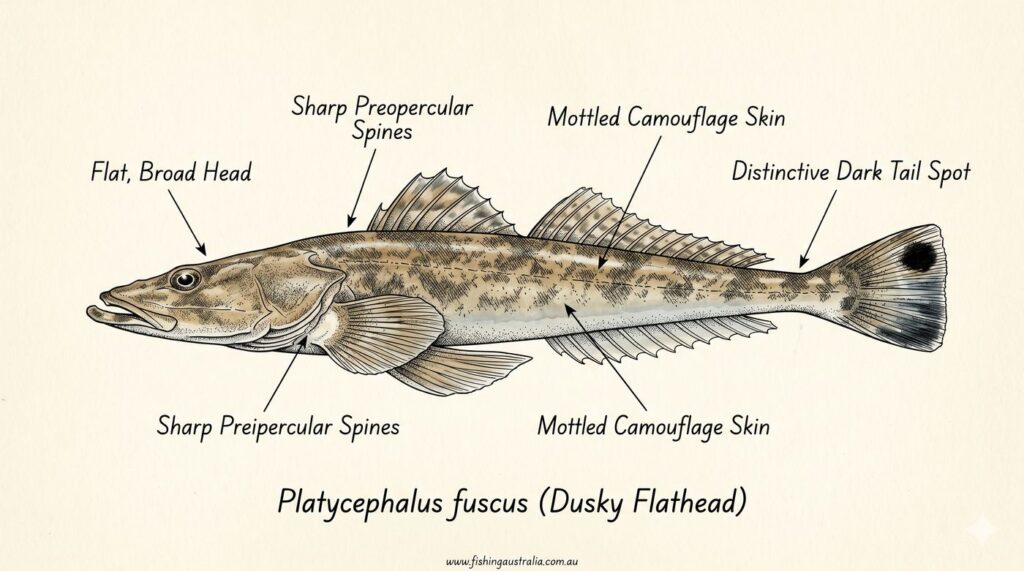
For any serious estuary fisho, a massive dusky flathead is the ultimate target. Often called crocs, lizards, or frogs by locals, any fish over seventy centimetres is a highly specialized, smart ambush predator. To catch these big girls consistently, you have to look past simple bait-fishing and understand how they live, spawn, and hunt.
This all comes down to a simple biological rule: the females grow massive, and the males don’t. Both grow quickly for their first three years, reaching about forty centimetres. But after that, their lives split. The males plateau, rarely growing past fifty centimetres, with a maximum length of around sixty-two centimetres and an eleven-year lifespan. They mature early at thirty-two centimetres. The females, however, keep growing for up to sixteen years, reaching over a metre in length and fifteen kilograms in weight. They mature much later, around fifty-five to fifty-seven centimetres. This means every single flathead you catch over seventy centimetres is a mature, spawning female.
Spawning runs from late October to April, when the females migrate downstream to estuary mouths to broadcast spawn. A big female doesn’t just lay a few more eggs; her breeding power is massive. A newly mature thirty-five centimetre female lays fewer than 150,000 eggs. An eighty-centimetre croc dumps upwards of two million eggs in a season—more than ten times the output of the smaller fish. When you keep these big girls, you wipe out a massive chunk of the next generation. Releasing them keeps our estuaries thriving.
The Big Lure Filter
In normal flathead fishing, three-inch soft plastics are the standard, and they work well for numbers. But if you are chasing real lizards over seventy centimetres, small lures are a waste of time. Big females are almost always surrounded by smaller, aggressive males between thirty and fifty centimetres. Because these little males are faster and greedier, a small plastic will get eaten by an undersized male before the big girl even sees it. This spooks the spot and ruins your chance.
To bypass the small stuff, switch to oversized lures from five to over nine inches. Big females want a massive caloric reward for very little effort, and they aren’t afraid of a giant meal.
Oversized soft plastics like the Daiwa Bait Junkie 6.2-inch Minnow are perfect. It has a deep body and a paper-thin slim waist design that lets the big boot tail thump with a heavy, low-frequency vibration even on a dead slow retrieve. This vibration travels through the water and pulls buried flathead out of the sand from metres away. The Keitech Swing Impact Fat 5.8-inch has a wider, slower body roll that glides beautifully on the drop to stay in the strike zone longer. For shallow flats, the giant Pro Lure XL Shad 200 soft swimbait is designed for a slow, hypnotic paddle-tail roll. You can insert tungsten nail weights into its underbelly to keep it tracking straight and deep in heavy current.
If you want to raise monsters, borrow heavy swimbaits from the cod and barra scene weighing forty to ninety grams. The Reel It In Garfish Swimbait is a six-segment sinking swimbait that perfectly copies the swimming action of local garfish, drawing flathead out of deep mud gutters. The Gancraft Jointed Claw 178SS is a slow-sinking glidebait that swims in a wide, lazy S-pattern, triggering territorial aggression from big, protective females. The Jackall Gantia 180 is multi-jointed and can be weighted to float, suspend, or sink. Nominally a floating bait, you can customize the Fish Arrow Glide Jack 180F for shallow flats by adding heavier, thicker treble hooks. This turns it into a suspending subsurface glidebait, letting you work it aggressively in less than a metre of water right over ribbon weed without fouling the hooks.
Topwater fishing in knee-deep water is the most visual game around. The OSP Bent Minnow 130 SW has a permanently curved, lip-less body that darts erratically, diving and rolling on its side like a dying baitfish. The wooden Crossfire 195 and 230 are brilliant when a stiff wind creates a surface chop, reflecting light off their curved profiles to trigger visual strikes. For super shallow water, the slender, rear-weighted Bassday Sugarpen 120 excels on a constant walk-the-dog retrieve, spraying water like a fleeing garfish or skipping prawn.
Join the Strike Club
Stop guessing when the estuary is going to fire. We track real-time barometric pressure shifts and tide changes for your local system, sending the exact bite windows straight to your phone.
See This Weekend’s Score →Defeating the Jaw Clamp
Pinning a solid hook into a flathead over seventy centimetres requires heavy-duty gear to overcome their main weapon: massive jaw clamp-force. Standard single-hook jigheads fail miserably on big crocs. Flathead have flat, wide skulls with incredibly strong jaw muscles. When they bite, they clamp down with crushing force. On a standard jighead, they clamp the plastic so hard that the hook is locked between their bony mouth plates. Because the hook can’t slide, you can’t drive the hook point home on the strike. When you pull, the lure is either ripped clean out of their closed mouth, or the fish holds on briefly before shaking the hook free at the surface.
To beat this clamp-force, use a custom under-belly or rear stinger treble system connected by high-tensile multi-swivel chains instead of rigid wire or mono, which snap under violent head-shakes. A multi-swivel chain spins freely, ensuring the stinger treble can rotate 360 degrees to grab the soft corner of the jaw. To rig this, thread your soft plastic straight onto a heavy jighead. Take a bait-threading needle and push it diagonally through the plastic’s belly, entering near the rear and exiting on the back right behind the jighead eyelet. Attach your trailing treble, like an extra-strong BKK Spear 21 or Decoy Y-S81, to a high-tensile multi-swivel chain using split rings. For mid-sized baits, use a Mikado Jaws Double Swivel; for bigger shads, use a Mikado Jaws Fourfold Swivel rated to thirty-five kilograms. Hook the leading swivel loop onto your threading needle, pull it back through the plastic, and slide the leading eyelet straight over the main jighead hook point. Lock it in place with a silicone bait button or lumo tubing. Pull the chain snug and pin one point of the trailing treble into the plastic’s belly. When a big croc clamps the lure, the body compresses, leaving the stinger free to grab hold.
Because flathead have thousands of tiny, abrasive teeth that act like sandpaper, you need a tough leader. Never run anything under fourteen-to-twenty pound fluorocarbon, like Platypus Hard Armour FC or Shimano Ocea. Fluorocarbon matches the refractive index of water, making it invisible to visual predators, and its high density sinks fast to keep your plastic hugging the bottom. There are exceptions. When throwing a wooden surface bait like the Crossfire 195, a heavy fluorocarbon leader actually pulls the nose slightly subsurface on long sweeps, creating a wet splash that mimics a panicked baitfish. Conversely, for smaller, lighter surface lures like the OSP Bent Minnow, stick to a fifteen-to-twenty pound monofilament leader like Platypus Hard Armour Supple. The floating mono prevents the nose of the light lure from dragging down, keeping its surface action perfect.
Shallow-Water Sight-Casting
Chasing trophy flathead is a shallow-water game, with many of the biggest females caught in less than a metre of water. Operating in the shallows requires top-tier polarized sunglasses to spot fish and read bottom structure without spooking them. Standard cheap sunnies won’t cut it. Serious fishos rely on advanced glass lenses, with Tonic Eyewear being the local benchmark.
These optical systems deploy specialized structural enhancements for clear sight on the flats:
- SliceLens Technology: Their ultra-thin glass is only 1.7 millimetres thick, giving you mineral-glass clarity at half the weight of traditional glass, preventing nose-bridge fatigue over long sessions.
- VistaView: This design cuts out visual distortion across the whole lens, giving you edge-to-edge clarity and exact depth perception.
- Anti-Reflective Coating: High-performance treatment on the back-surface of the lens cuts glare by forty-five percent, letting your eyes focus completely on what is happening under the water.
To spot fish against sand and seagrass, you need the right lens color:
- Copper Photochromic: Lenses with this tint serve as the sight-casting benchmark, boosting yellow tones to enhance bottom transitions and edge definition on broken weed flats.
- Grey Photochromic or Green Mirror: Lenses configured with these finishes excel in high-glare, bright sun over highly reflective white sandbanks.
With good glasses, you must actively target key structures rather than drifting aimlessly:
- Weed Edges: Focus on transition zones where dense ribbon weed meets clean sand—the prime ambush lane where flathead wait for bait to drift by.
- Melon Holes: Circular depressions left by feeding stingrays or formed by localized current washouts. These hold deeper, cooler water as the tide drops, concentrating active baitfish.
- Sand Patches: Clean patches of sand inside thick weed beds are premium target areas, representing the only spots where flathead can bury under the sediment to hide.
- Flathead Lies: Kite-shaped imprints left in the sand by recently departed fish. Spotting a fresh lie is proof of life. Because flathead are territorial, a fresh lie means a fish is close by. Note the direction of the imprint, which shows which way the fish was facing into the current, and cast up-current to intercept the resettled croc.
Working the Lure and Dirty Water Tactics
Even the best rig will fail if your retrieve is wrong. Flathead are ambush hunters that rely on camouflage and short, explosive bursts of speed. To get a bite, you must trigger their predatory attack reflex. Since ninety percent of flathead strikes happen as the lure falls back to the sand, the slack line drop is the ultimate retrieve.
Start with the lure resting on the bottom, then execute a sharp, double-flick of the rod tip to lift the lure a metre off the sand, kicking up a mud plume like a fleeing prawn. Immediately drop the rod tip to let the lure fall on a semi-slack line. Avoid a tight line, which drags the lure forward and kills the action of the tail. Lock your eyes on your braid where it enters the water. If the line twitches or stops dropping, wind up the slack and set the hook hard. If you try to feel the bite through the rod tip, you will miss it. When a big female inhales a big plastic on the drop, she quickly settles back onto the sand. Because the line is slack, you won’t feel a tap. By the time you feel it, the fish has detected the hard lead jighead and spat the lure out. Keep your eyes glued to the braid.
Estuary conditions can change fast, with run-out tides, wind, and boat traffic turning clean water dirty. Because flathead hunt by sight, dirty water narrows their strike zone. To beat this, use high-contrast, UV-active colors like Coconut Ice, hot pink, chartreuse, or solid pearl white to create a sharp silhouette against the mud. You must also load the lure with strong, garlic- or fish-oil-based scent, like Pro-Cure or S-Factor, smeared into the ribs and belly slit. This creates a concentrated scent trail in the water that the flathead tracks straight to the vibrating lure.
Search Tactics and Releasing Spawners
A structured search plan is what separates consistent tournament anglers from those who just get lucky. When covering large sandbanks or long estuary channels, casting giant swimbaits all day is exhausting and slow. Elite fishos use a scout lure strategy to locate active zones fast.
Rig a light spin outfit with a fast-moving 100-millimetre scout lure, like a Daiwa Double Clutch, a TT Quake vibe, or a ZMan 3-inch MinnowZ. Fan your casts in a clock-face pattern to cover 180 degrees, focusing on drains, gutters, and weed edges. Smaller male flathead gather in high numbers around spawning females during the breeding season. Finding a cluster of smaller fish is the ultimate sign that a giant female is close by. The moment you catch a small flathead or spot a fresh lie, put the light rod away. Pick up your heavy gear, tie on a six-to-nine-inch lure, and cast straight back into that same spot.
Protecting these breeding females is critical. In Victoria, you are limited to five fish within a thirty-to-fifty-five centimetre slot limit, with fines exceeding four hundred dollars if you hold undersized or oversized fish. Victoria also requires you to keep your catch whole while on the water to ensure slot integrity; filleting is only allowed at land-based cleaning tables. New South Wales enforces a thirty-six to seventy-centimeter slot, and Queensland sets their slot at forty to seventy-five centimeters, both carrying heavy penalties and five-fish daily limits.
Research shows flathead are incredibly tough. If handled correctly, their post-release survival rate is over ninety percent. In fact, tagging data shows over fourteen percent of tagged breeding females over seventy centimetres are recaptured, proving they survive to spawn again.
To keep them alive, you must adhere to strict handling and release protocols:
- Landing: Always land your fish using a knotless silicone net like an Environet. Standard nylon nets scrape off their protective slime, leaving them open to deadly infections.
- Lifting: Never hold a big flathead vertically by the jaw. Their skeleton cannot support their weight, and vertical hanging tears ligaments and ruptures internal organs. Keep them horizontal, supporting the heavy belly with a wet hand.
- Contact: Never lay them on a hot, dry boat deck or dry sand. Use a wet mat, keep air exposure under sixty seconds, and swim the fish in the water before release.
- Wading Reflex: When wading on foot, handling a thrashing flathead is dangerous due to their sharp gill spikes. Waders use a clever trick called the thumb-on-bum hold. Flip the flathead onto its back in the water and press your thumb gently on its anal vent. This pressure triggers a reflex that makes the fish freeze completely. This keeps your hands safe from their spikes and lets you remove hooks with long-nosed pliers without ever lifting the fish from the water.
Never Launch Into a Donut Again
Your fishing time is too valuable to waste on dead water. Join the Strike Club to get our weekly, data-backed bite alerts, tracking tides, wind-chop, and barometric pressure swings for your local estuary.
Get the Local Edge →Compiled by the Editorial Team at FishingAustralia.com.au. All biological data and regulatory guidelines are fully grounded in the Status of Australian Fish Stocks (SAFS) and state fisheries authorities.